
Description
ISBN: 9780473786755
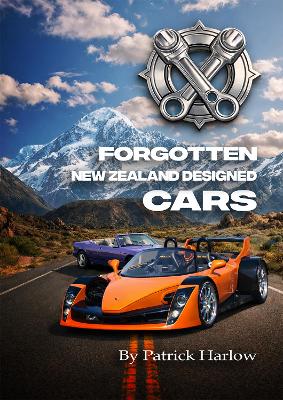
Title: Forgotten New Zealand Designed Cars
Author: HARLOW PATRICK
Most people, when asked, will be unable to identify any
locally designed car; a few may name the Trekka. It is unlikely that any will
mention the Heron MJ1. All will be surprised to learn that there are about 80
New Zealand designed cars in this book and I know that there are more still lurking
in the shadows of history.
To date, this book is the only book written about New Zealand’s
unique, locally designed and produced cars. It will not include vehicles like
the Vauxhall Viva Score 7, the Chris Amon Corolla, or the Humber 80, as they
were cars designed in Japan and England but featured New Zealand-designed
badging and trim. This book is about production and prototype cars that were
unique to New Zealand or designed by Kiwis. It will include a Lotus, because, for
a very short time, while Colin Chapman was CEO of Lotus, a genuine Lotus car was
designed and manufactured in this country, with two prototypes produced before
fears of legal action from the USA put an end to it.
As it is often too expensive to tool up with dies to press sheet
metal panels, the cars in this book are mostly fibreglass. When most people
talk about fibreglass sports cars, the first example that will come to mind is
generally the Chevrolet Corvette and the second maybe a Lotus or possibly the
TVR. After that, most will start to struggle. With a bit of a stretch, some
will think of Avanti and maybe even the Kaiser-Darin or the Daimler SP250.
Sadly, it is doubtful if any unique New Zealand cars will be a part of that
conversation. Hopefully, these stories can start to change that.
The Cobra, Lotus 7 and other fibreglass replica sports cars made in
this country will be excluded from this list as they have been featured in my
earlier book, ‘New Zealand Manufactured Cars – A Cottage Industry’. Some of the
cars from that book that are not replicas will appear in this book with updated
facts and pictures.
All the cars that will appear in this book are full of Kiwi
DNA and showcase just how good we are at designing cars. A large number of these
cars will be unknown, forgotten about or have faded into obscurity. About two-thirds
of them were sold as a kit set, but all of them could be bought ready to be
driven straight from the factory (turn-key).
Due to the small New Zealand population, the market for a locally
designed and built car is correspondingly small and at best can be described as
niche. The heyday for our industry was from the ’80s through to the early
2000s. During this period, around 40 different manufacturers were competing for
the same niche dollar. Most were kit car manufacturers, many of which also
produced turn-key, with a few turn-key only manufacturers amongst them. Many
that started in the ’80s were gone before the new millennium started. It was a
very competitive market with only Almac surviving through to the 2020s.
Back in the heyday, it could be considered a success if a business
sold 10 cars. Due to the size of the local market, in most instances, these
cars were sold as a sideline to the main business. Only a handful of companies
broke into triple figures.
Most who read this will have heard of the Trekka. It was only ever sold as a turn-key car and
is just one of many homegrown vehicles manufactured in this country. This book will introduce the reader to a
whole world of cars that have been forgotten.
What is it that constitutes a New Zealand designed car?
I’m sure that more than a few cars in this list will be
controversial. In most instances, vehicles in this list have borrowed parts
from other cars. Just as the Chevrolet Camaro, which uses the Holden Commodore
floorpan, a small number of cars in this list have used a VW or Triumph Herald
chassis. Similarly, most low-volume car manufacturers get their engines from
other sources, such as McLaren getting its engines from Mercedes and Lotus from
Toyota. With the exception of the DNS390, which utilises a locally designed V8,
all the cars in this list use engines and drivetrains provided by other
manufacturers.
New Zealand will never be able to produce the volume of cars
for its local market that overseas companies like Ford and GM. Even when all
the big brands were assembling cars here, generally 80 percent of the parts
were imported, with the rest being made locally.
There are no replicas in this list.
None of the cars in this list should be considered a replica,
though some readers will question this as they browse this book. In much the
same way that the first-generation Toyota MR2 was inspired by the Fiat X18, the
second by the Ferrari 365 and the third by the Porsche Boxster. Like the
Toyota, some of these cars have been inspired by other production cars and look
similar; however, no dimension or part has been shared from whatever car that
inspired the New Zealand car’s inception.
A book of achievers
None of the people who created the cars in this
list should be seen as failures, despite some never getting past the prototype
stage. The fact that the car attained the prototype stage is an amazing
achievement and a credit to the people involved in its creation. In most
instances, the main reason these cars were not a success is that most New
Zealanders have a distrust of anything that is produced locally, especially if
it is an automobile.
Format: Hardback
Publication date: 01/02/2027
Available stock: 3
RRP: $80.00



Reviews
There are no reviews yet.